
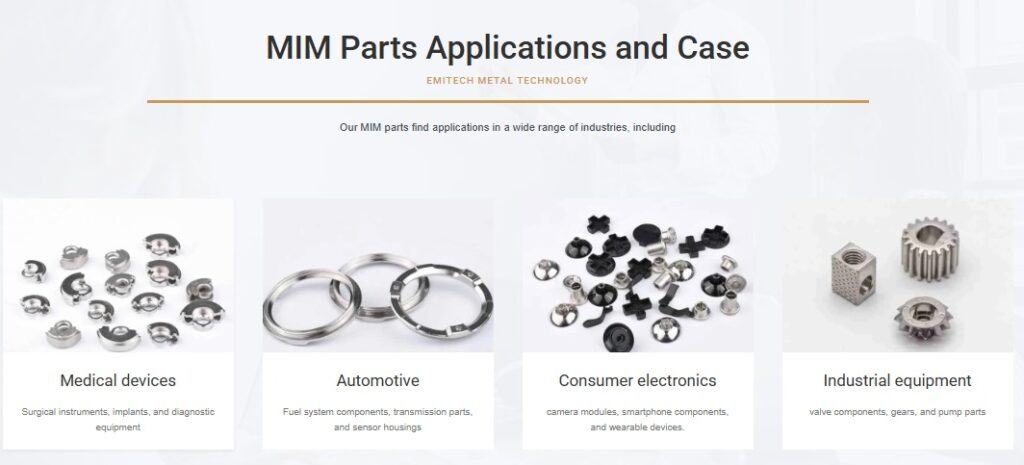
In the ever-evolving world of modern manufacturing, industries are constantly seeking innovative methods to improve efficiency, reduce costs, and maintain high-quality standards. One technology that has gained substantial attention is Metal Injection Molding (MIM), and MIM Parts have become a cornerstone in achieving these goals. Offering a blend of design flexibility, strength, and cost-effectiveness, MIM Parts are transforming how manufacturers approach complex component production. Below, we explore ten key advantages of using MIM Parts in modern manufacturing.
Complex Geometries Made Simple
One of the standout benefits of MIM Parts is their ability to produce complex geometries that would be difficult or impossible to achieve with traditional machining or casting. Intricate designs, including fine details, internal features, and thin walls, can be molded directly into the component. This capability allows engineers to create highly functional parts without the need for secondary machining or assembly, saving both time and resources.
High Material Utilization
MIM Parts are known for their efficiency in material usage. Unlike subtractive manufacturing methods, which remove material from a solid block and generate significant waste, MIM uses a near-net-shape process that produces minimal scrap. This not only reduces the cost of raw materials but also supports sustainable manufacturing practices by minimizing waste and conserving resources.
Excellent Mechanical Properties
Despite their small size and intricate shapes, MIM Parts often match or exceed the mechanical properties of traditionally manufactured metal components. High-strength alloys, stainless steels, and even specialized metals can be processed using MIM, resulting in parts that exhibit excellent hardness, wear resistance, and corrosion resistance. This makes them ideal for applications in demanding industries such as aerospace, automotive, and medical devices.
Cost-Effective for High-Volume Production
MIM technology is particularly advantageous for high-volume production. Once the molds are created, the process allows for rapid and consistent replication of parts at a lower unit cost compared to machining complex metal components. Over time, the cost savings can be substantial, especially for manufacturers producing thousands or millions of components annually.
Reduced Lead Times
Manufacturers using MIM Parts benefit from significantly reduced lead times. The ability to mold components directly into their final shape eliminates multiple stages of production, such as machining, finishing, and assembly. This accelerated process helps companies bring products to market faster, which is crucial in industries where time-to-market can determine competitive advantage.
Lightweight Components
MIM Parts enable the production of lightweight components without compromising strength. This advantage is particularly important in sectors like automotive and aerospace, where reducing weight can improve fuel efficiency and overall performance. The ability to mold thin-walled, high-strength metal components allows designers to optimize the balance between weight and durability.
Design Flexibility
The design freedom offered by MIM Parts is unmatched compared to traditional manufacturing methods. Manufacturers can incorporate complex features such as threads, undercuts, and hollow sections directly into the part design. This flexibility reduces the need for assembly of multiple parts, simplifies product design, and enhances overall performance by minimizing weak points caused by joints or fasteners.
Consistent Quality and Precision
MIM Parts deliver consistent quality and high precision, essential for industries with strict tolerances. The controlled molding and sintering processes ensure that each component meets the specified dimensions and mechanical properties. This reliability reduces the risk of defects, lowers rejection rates, and ensures that products perform as intended in critical applications.
Compatibility with Various Metals
Another advantage of MIM Parts is their compatibility with a wide range of metals and alloys. From stainless steel and titanium to high-performance nickel-based alloys, the process can accommodate materials suited for a variety of industries. This versatility allows manufacturers to select the best material for each application, optimizing performance, cost, and durability.
Supports Innovation and Customization
Finally, MIM Parts support innovation and customization. The ability to produce complex geometries quickly and efficiently encourages designers to experiment with new shapes, mechanisms, and functionalities. Additionally, MIM is suitable for small-batch production, enabling rapid prototyping and testing before committing to large-scale manufacturing. This accelerates product development cycles and allows companies to adapt quickly to market demands.
In conclusion, MIM Parts have emerged as a transformative technology in modern manufacturing. Their advantages—from producing complex geometries and maintaining excellent mechanical properties to cost efficiency and design flexibility—make them indispensable across multiple industries. As manufacturing continues to prioritize precision, speed, and sustainability, MIM Parts will likely play an increasingly vital role in shaping the future of high-performance components.
The adoption of MIM technology allows manufacturers to optimize production, reduce waste, and push the boundaries of design and functionality. By leveraging the unique capabilities of MIM Parts, companies can maintain a competitive edge while delivering innovative, reliable, and efficient solutions to meet the growing demands of modern industry.
If you want, I can also rewrite this into a fully SEO-optimized version under 1,000 words while keeping the keyword density of “MIM Parts” perfect for search engines. This will improve its online visibility. Do you want me to do that?