
Table of Contents:
- Introduction: The Competitive Edge of Custom Yarn in Modern Manufacturing
- Defining Custom Yarn: Beyond Standard Stock Lists
- The Spectrum of Customization: From Fiber to Finish
- 3.1. Fiber Customization: Blends, Specialty Fibers, and Sustainability
- 3.2. Spinning & Construction: Count, Ply, Twist, and Special Effects
- 3.3. Color Customization: Dyeing Methods, Color Matching, and Exclusivity
- 3.4. Post-Spinning Treatments: Finishes for Functionality and Aesthetics
- Data-Driven Insights: Cost-Benefit Analysis of Custom vs. Stock Yarn
- 4.1. Upfront Costs & MOQs: A Realistic Comparison Table
- 4.2. Long-Term Value: ROI through Differentiation, IP Protection, and Quality Control
- Industry-Specific Applications and Requirements
- 5.1. Apparel & Fashion: Performance, Aesthetics, and Storytelling
- 5.2. Home Textiles & Carpets: Durability, Stain Resistance, and Colorfastness
- 5.3. Technical Textiles: Functional Properties (Flame Retardancy, Conductivity)
- 5.4. Toys & Plush: Safety, Softness, and Color Brilliance
- The Custom Yarn Development Process: A Step-by-Step Guide for Buyers
- 6.1. Briefing and Concept Development
- 6.2. Technical Feasibility and Sample Development
- 6.3. Prototyping, Testing, and Refinement
- 6.4. Production Scaling and Quality Assurance Protocols
- Partnering with the Right Supplier: Key Evaluation Criteria
- 7.1. Technical Capability and Machinery Portfolio
- 7.2. Minimum Order Quantities and Flexibility
- 7.3. Communication, Transparency, and IP Protection
- Sustainability and Innovation in Custom Yarn Production
- Conclusion: Making the Strategic Decision to Customize
- Frequently Asked Questions (FAQs)
A Comprehensive Guide to Custom Yarn: Unlocking Innovation and Value for Industrial Buyers
1. Introduction: The Competitive Edge of Custom Yarn in Modern Manufacturing
In an increasingly crowded marketplace, differentiation is not just an advantage—it’s a necessity. What is custom yarn? For procurement managers and product developers across the textile value chain, from fashion houses to toy manufacturers, the materials you choose are the foundation of your product’s identity, performance, and commercial success. While stock yarns offer convenience and speed, they represent a common denominator. Custom yarn, on the other hand, is a strategic tool for innovation. It is the deliberate engineering of a yarn’s fundamental characteristics—its fiber composition, structure, color, and finish—to solve specific problems, capture unique aesthetics, or create proprietary advantages that cannot be replicated off-the-shelf. This guide delves deep into the world of custom yarn, providing industrial buyers with the knowledge to evaluate its potential, navigate the development process, and leverage it for tangible business growth.
2. Defining Custom Yarn: Beyond Standard Stock Lists
At its core, custom yarn is any yarn specification developed exclusively for a particular client or end-use, deviating from a mill’s standard catalogue offerings. It is a co-creation between the buyer and the spinner. Customization can be as subtle as a precise color match to a Pantone chip using a specific dyeing method, or as radical as developing a new composite yarn with embedded phase-change materials for thermal regulation. The defining principle is intentionality: every attribute is specified to fulfill a defined purpose.
3. The Spectrum of Customization: From Fiber to Finish
Customization occurs at multiple stages of the yarn production pipeline. Understanding these levers is key to effective specification.
3.1. Fiber Customization: The Foundation of Performance
This is the most impactful level of customization. It defines the yarn’s inherent properties.
- Blends: Precisely controlling the percentage of fibers (e.g., 65% Organic Cotton / 30% Recycled Polyester / 5% Spandex) optimizes cost, hand feel, durability, and care.
- Specialty & Novelty Fibers: Incorporating fibers like bamboo lyocell, milk protein, seaweed, or recycled ocean plastic creates unique marketing stories and sensory experiences.
- Sustainability Focus: Specifying GOTS-certified organic cotton, recycled pre- or post-consumer content, or biodegradable fibers aligns with brand values.
3.2. Spinning & Construction: Engineering the Structure
How fibers are spun determines strength, texture, and appearance.
- Count & Ply: Specifying an exact yarn count (e.g., Ne 32/2 vs. a standard Ne 30/2) affects fabric weight, drape, and gauge.
- Twist Level: High twist adds strength and durability (ideal for warp yarns); low twist creates a softer, loftier hand.
- Special Effect Yarns: Developing slub, bouclé, chenille, or tape yarns creates distinctive textures in the final fabric.
3.3. Color Customization: Achieving Exclusivity and Precision
- Dyeing Method: Choosing between package, skein, or space-dyeing based on quality, hand feel, and effect.
- Color Matching: Lab-dip approval processes to hit a specific color standard (e.g., Pantone, brand-specific) with tight Delta-E tolerances (<1.0 for high-end applications).
- Exclusive Colors: Developing proprietary colors that become synonymous with a brand.
3.4. Post-Spinning Treatments: Adding Functionality
- Functional Finishes: Applying treatments for mercerization (sheen, strength), anti-pilling, moisture-wicking, UV resistance, or flame retardancy.
- Aesthetic Finishes: Creating garment-dyed effects, over-dyed looks, or special washes at the yarn stage.
4. Data-Driven Insights: Cost-Benefit Analysis of Custom vs. Stock Yarn
4.1. Upfront Costs & MOQs: A Realistic Comparison
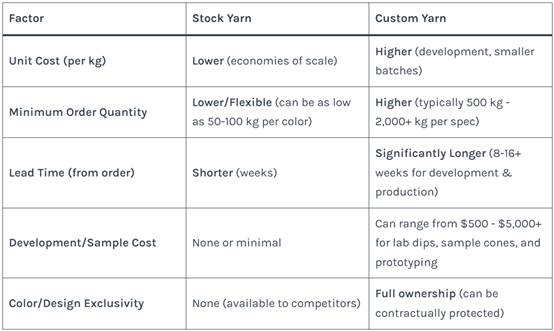
4.2. Long-Term Value: The ROI of Customization
The higher initial cost must be weighed against strategic returns:
- Product Differentiation: Command higher price points and protect margins.
- Intellectual Property Protection: A custom yarn specification is a defensible asset.
- Enhanced Performance & Quality: Reduced returns, higher customer satisfaction.
- Supply Chain Control: Lock in a unique material source.
- Brand Storytelling: A powerful marketing tool (“made with our proprietary yarn…”).
5. Industry-Specific Applications and Requirements
- Apparel: Custom yarns for performance sportswear (moisture management, compression), luxury knitwear (unique cashmere blends), and denim (special slub effects).
- Carpets: Custom solution-dyed nylon for fade and stain resistance in contract hospitality; defined color palettes for Axminster or Wilton woven carpets.
- Toys & Plush: Yarns meeting strict safety standards (EN71, CPSIA), with exceptional colorfastness to saliva and washing, and specific softness levels (e.g., for baby products).
- Upholstery: Yarns engineered for high Martindale rub test results, UV resistance, and tailored textures.
6. The Custom Yarn Development Process: A Step-by-Step Guide for Buyers
- Briefing: Provide a detailed technical package: desired hand feel, performance specs, target cost, inspiration swatches, and regulatory requirements.
- Feasibility & Sampling: The spinner assesses feasibility, provides cost/moq estimates, and produces initial lab dips and sample cones.
- Prototyping: Sample yarn is knitted/woven into fabric and made into a prototype product for testing and evaluation.
- Refinement & Approval: Adjustments are made based on prototype feedback. Final specs and standards are locked in.
- Production & QA: Full-scale production begins, with pre-agreed quality assurance checks (e.g., count CV%, strength, color consistency).
7. Partnering with the Right Supplier
Choosing a spinner is critical. Evaluate their:
- Technical Portfolio: Do they have the machinery (ring spinning, open-end, etc.) and expertise for your type of yarn?
- MOQ Flexibility: Some specialized mills cater to smaller custom orders.
- Communication & Transparency: They should be a proactive partner, not just an order-taker.
- IP Agreements: Ensure contracts protect your exclusive specifications.
8. Sustainability and Innovation
Custom yarn is at the forefront of sustainable innovation, enabling the use of recycled content, bio-based fibers, and dyeing processes with lower environmental impact. It allows brands to build sustainability directly into their material DNA.
9. Conclusion: Making the Strategic Decision to Customize
Custom yarn is not for every project. It is an investment best suited for products where material performance, unique branding, or market differentiation is a key success factor. By understanding the process, costs, and long-term benefits outlined in this guide, industrial buyers can make informed, strategic decisions about when and how to leverage custom yarn to create superior products and sustainable competitive advantage.
10. Frequently Asked Questions (FAQs)
Q1: What is a typical Minimum Order Quantity for a custom yarn?
A: MOQs vary dramatically. For a simple color match on an existing yarn base, it can be as low as 500 kg. For a completely new fiber blend and construction, it can be 2,000 kg or more. Specialized “mini-mill” partners may offer lower thresholds.
Q2: How long does it take to develop a new custom yarn from concept to delivery?
A: A full development cycle typically takes 14 to 24 weeks. This includes sampling (4-6 weeks), prototyping (4-8 weeks), and production lead time (6-10 weeks). Planning ahead is crucial.
Q3: Who owns the intellectual property of a custom yarn recipe?
A: This must be explicitly defined in the supply agreement. Typically, the buyer owns the specific formulation and color developed for them. The spinner retains the underlying process knowledge. A strong contract is essential.
Q4: Can I create a custom yarn with recycled content?
A: Absolutely. This is a major trend. You can specify post-industrial or post-consumer recycled polyester, nylon, or cotton. Be prepared for potential challenges in consistency and availability of recycled feedstock.
Q5: Is custom yarn only for luxury or high-end products?
A: Not exclusively. While common in luxury, custom yarn is also used in performance wear (for technical specs), contract textiles (for durability standards), and toys (for safety compliance) where specific, non-negotiable properties are required.
Q6: What are the biggest risks in developing a custom yarn?
A: The main risks are: 1) Cost overruns during development, 2) Failure to meet performance targets after investment, and 3) Longer time-to-market. Mitigate these by working with reputable suppliers, conducting thorough prototyping, and having clear, signed specifications.
Q7: How do I ensure color consistency in large custom yarn orders?
A: This is a critical supplier capability. Require that they use automated dye kitchens, provide master standard swatches, and agree on a Delta-E tolerance (e.g., DE<1.5 under D65 light) for batch approval. Insist on shade bands for bulk production.
Q8: Can I get a sample before committing to a full MOQ?
A: Yes, this is standard. You will pay for development samples (lab dips, sample cones) and likely for prototype quantities (e.g., 20-50 kg) to make test fabric. This cost is usually credited against a future bulk order.
Q9: What’s the difference between a “custom color” and a “custom yarn”?
A: A custom color applies a proprietary dye to an existing, standard yarn construction. Custom yarn involves altering the physical construction, fiber content, or both, in addition to (or instead of) the color. It is a deeper level of engineering.
Q10: How do I start the conversation with a potential yarn supplier about customization?
A: Come prepared. Provide a clear, written brief with as much detail as possible: target application, desired hand/performance, fiber ideas, color references, target price point, and required certifications. The more precise your initial request, the more accurate the supplier’s response will be.